Executive Summary:
Sonic Automotive Inc (NYSE: SAH) is one of the largest automotive retailers in the United States, operating a diversified portfolio of franchised dealerships, powersports stores, and its rapidly expanding EchoPark used-vehicle brand. Following a record-breaking 2025 where full-year revenues hit $15.2 billion, the company has maintained steady momentum into early 2026, driven largely by robust fixed operations (parts and service) and finance and insurance (F&I) margins.
Licenced Educational Disclaimer: This analysis is for educational purposes only and should not be considered personal financial advice. This analysis constitutes general financial product advice and does not take into account your individual objectives, financial situations, or needs. Investors should conduct their own thorough research and seek independent financial advice from a licensed professional before making any investment decisions.
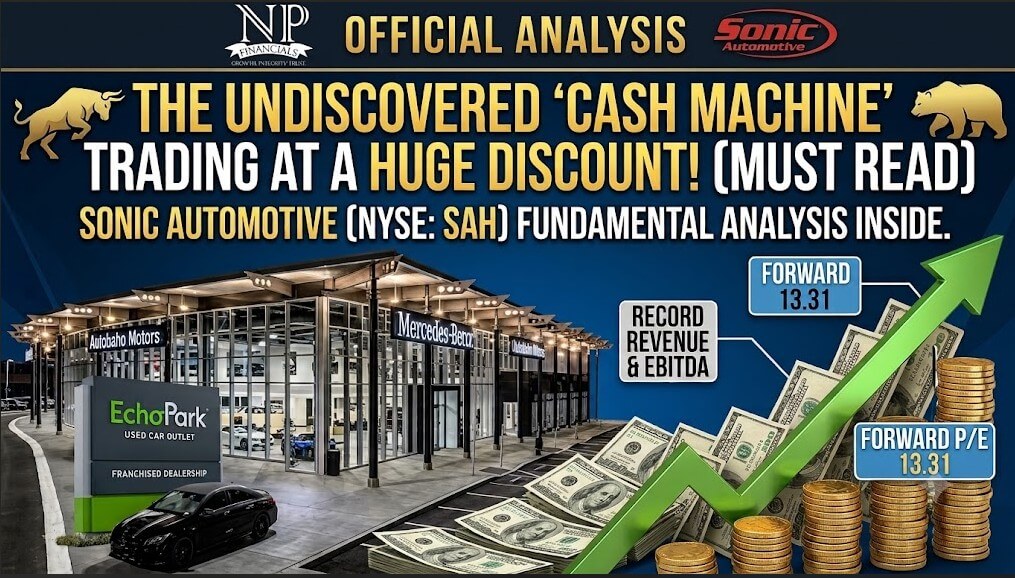
For long-term investors, Sonic Automotive presents a fascinating fundamental case. The core franchised dealership segment serves as a powerful cash cow, funding the aggressive expansion of the high-margin EchoPark and Powersports divisions. While the company faces typical cyclical automotive risks and carries substantial floor plan debt on its balance sheet, its current forward P/E of just 13.31 and aggressive share repurchase program highlight management’s confidence in their strategic pivot. This report will break down the fundamental quality, competitive moat, and valuation of Sonic Automotive to determine if it deserves a spot on your investment watchlist.

Company Overview
Sonic Automotive operates through a diversified business model designed to capture revenue across the entire lifecycle of a vehicle.
-
Business Model & Operations: Sonic operates three main reportable segments:
-
Franchised Dealerships: The traditional core business, comprising 111 stores and 134 new vehicle franchises across 24 brands in the US.
-
EchoPark: A standalone used-vehicle retail brand consisting of 18 stores. EchoPark focuses on one-to-four-year-old pre-owned vehicles, offering a haggle-free, guest-centric digital and physical shopping experience.
-
Powersports: Operating 14 locations and 41 franchises, this segment sells motorcycles, ATVs, and watercraft.
-
-
Geographic Presence: The company operates entirely within the United States, with a strategic concentration in high-growth Sunbelt states.
-
Revenue Sources (2025): While new vehicle sales make up 47% of revenue, the real profit engines lie elsewhere. Fixed Operations (parts, service, and collision) contribute 43% of total gross profit, while F&I (Finance & Insurance) generates 34% of total gross profit.
Why Investors Are Watching This Company
Investors are closely tracking SAH in 2026 due to several major developments and structural advantages:
-
The EchoPark Turnaround: After initial expansion hurdles, the EchoPark segment is proving its financial viability. In Q1 2026, EchoPark posted an all-time record adjusted EBITDA of $18.6 million, cementing its role as a future growth catalyst.
-
Aggressive Capital Return: Management is heavily rewarding shareholders. In April 2026, the Board approved an additional $500 million for share repurchases. Coupled with a quarterly dividend of $0.41 (yielding roughly 1.77%), the total shareholder yield is highly attractive.
-
Margin Resilience: Despite a 10% volume drop in same-store retail new vehicles in Q1 2026, Sonic maintained flat gross profits by leveraging high-margin Fixed Operations and F&I segments.

Industry Analysis
The US auto retail market is a highly fragmented, multi-hundred-billion-dollar industry currently undergoing a digital transformation.
-
Industry Size & Growth: The automotive retail sector remains robust, though it is cyclical and sensitive to interest rates and macroeconomic conditions. The used-car market, where EchoPark operates, is historically counter-cyclical, providing a buffer when new car sales slow down.
-
Competitive Landscape: Sonic competes with major publicly traded dealership groups like AutoNation, Lithia Motors, and Group 1 Automotive, as well as digital disruptors like Carvana.
-
Future Outlook: The industry is consolidating. Smaller, family-owned dealerships are struggling to keep up with the capital required for digital retailing and EV infrastructure. Well-capitalised giants like Sonic are positioned to acquire these smaller players at attractive valuations.
Competitive Advantages (Economic Moat)
Sonic Automotive benefits from a Narrow Economic Moat, primarily driven by intangible assets and switching costs.
-
Franchise Laws (Intangible Assets): State franchise laws strictly protect incumbent auto dealers. These regulations make it incredibly difficult for manufacturers (OEMs) to open direct-to-consumer stores or for new competitors to set up rival dealerships in the same geographic territory.
-
High-Margin “Sticky” Services (Switching Costs): Modern vehicles are essentially rolling computers. When a car needs complex servicing, consumers are heavily incentivised to return to the franchised dealer rather than a third-party mechanic. This drives the incredibly profitable Fixed Operations segment.
-
Scale Advantages: Sonic’s massive scale allows it to secure better financing rates, bulk inventory purchasing, and lower per-unit advertising costs compared to independent dealers.
Revenue Analysis
Sonic has demonstrated an impressive ability to grow its top line while pivoting its business model.
| Metric | FY 2024 | FY 2025 | YoY Growth |
| Total Revenue | $14.22 Billion | $15.15 Billion | +7.0% |
| Gross Profit | $2.19 Billion | $2.38 Billion | +9.0% |
-
Consistency & Diversification: In Q1 2026, the company recorded $3.69 billion in revenue. While new car volumes dipped, Fixed Operations gross profit grew 5% and F&I gross profit grew 2% on a same-store basis. This diversification smooths out the cyclicality of vehicle sales.
Profitability Analysis
Profitability metrics indicate a business that is highly efficient at extracting value from its operations, despite high top-line costs.
-
Gross Margin: Trailing twelve months (TTM) gross margin sits at 15.90%. This is solid for an auto retailer, driven by the outsized contribution of the high-margin parts and service division.
-
Operating & Net Margin: The TTM operating margin is 3.44%, while the net margin is lower at 0.72%. Auto retail is inherently a low-net-margin, high-volume business.
-
Earnings Growth: While FY 2025 GAAP net income fell due to non-cash impairment charges, adjusted net income for FY 2025 actually rose 17% to $229.2 million. In Q1 2026, adjusted EPS was $1.62, representing a 9% year-over-year increase.
Balance Sheet Strength
A dealership’s balance sheet looks different from a standard company due to the nature of “floor plan financing”—the short-term debt used specifically to finance vehicle inventory.
-
Cash & Liquidity: As of March 31, 2026, Sonic held $381 million in cash and floor plan deposits, with total liquidity reaching approximately $770 million.
-
Debt Levels: Total debt sits at roughly $4.43 billion. A significant portion of this is floor plan debt, which is collateralised by the vehicles themselves and routinely paid off as cars are sold.
-
Financial Stability: We rate the balance sheet as Average to Strong. While the Debt-to-Equity ratio appears highly elevated at over 450%, this is standard industry practice. The company’s massive liquidity pool provides ample downside protection.
Cash Flow Analysis
Cash flow is the lifeblood of automotive retail, dictating the ability to acquire new dealerships, fund EchoPark, and buy back stock.
-
Capital Allocation: Sonic has proven to be a cash-generating machine. In Q1 2026 alone, the company repurchased 2.1 million shares for $135.7 million (retiring 6% of its outstanding shares in just three months).
-
Why it Matters: Strong operational cash flow proves that Sonic’s reported earnings are backed by real cash generation, not just accounting adjustments. It allows management to aggressively return value to shareholders without jeopardising daily operations.
Return Metrics
How well is management using shareholder capital to generate profits?
-
Return on Equity (ROE): TTM ROE sits at 10.51%. This is a healthy figure, suggesting management is generating a reasonable return on the equity base.
-
Return on Assets (ROA): TTM ROA is 5.45%. Given the capital-intensive nature of the business (holding billions in physical vehicles and dealership real estate), a 5.45% ROA is highly respectable.
Management Quality
-
Strategic Decisions: Management’s decision to incubate EchoPark and the Powersports segments is bearing fruit. EchoPark’s record adjusted EBITDA of $49.2 million in FY 2025 proves the concept works. Furthermore, management plans to resume the disciplined expansion of the EchoPark footprint in late 2026.
-
Capital Allocation: Management is exceptional at capital allocation. The aggressive share buybacks—particularly the recent $500 million authorisation—demonstrate a commitment to increasing the ownership stake of continuing shareholders at attractive valuations.
Valuation Analysis
At current price levels (approximately $94–$99 in mid-2026), SAH presents a compelling value proposition.
-
Price-to-Earnings (P/E): The TTM P/E is elevated at 29.98 due to past impairment charges, but the Forward P/E is a very attractive 13.31.
-
Price-to-Sales (P/S): A remarkably low 0.21, underscoring the massive revenue scale of the business relative to its $2.9 billion market capitalisation.
-
EV/EBITDA: Trading at 9.82x, which is reasonable for a mature retailer with a high-growth subsidiary (EchoPark).
Verdict: Based on historical averages and industry peers, Sonic Automotive appears Undervalued to Fairly Valued. If EchoPark can maintain its profitability trajectory, the sum-of-the-parts valuation could be significantly higher than the current share price.
Growth Opportunities
-
EchoPark Expansion: With profitability achieved, management plans to resume expanding physical EchoPark locations in late 2026, tapping deeper into the highly fragmented used-car market.
-
Powersports Segment: An often-overlooked division, Powersports generated a record $40.9 million in revenue in Q1 2026 (up 19% YoY). This niche market offers higher margins and less direct competition.
-
Industry Consolidation: Sonic’s $770 million liquidity pool allows it to acquire smaller, struggling independent franchised dealerships at discounted valuations.
Key Risks
-
Economic & Cyclical Risks: Auto sales are highly sensitive to interest rates, inflation, and consumer credit availability. Higher rates increase the cost of floor plan financing and increase monthly payments for consumers.
-
OEM Disintermediation: There is an ongoing risk that manufacturers (like Ford or GM) may attempt to replicate the direct-to-consumer model pioneered by Tesla, bypassing franchised dealers.
-
Inventory Valuations: The used-vehicle market is subject to rapid price deflation. A sudden drop in used car prices could force Sonic to write down the value of its EchoPark inventory.
SWOT Analysis
| Category | Assessment |
| Strengths | Diversified revenue streams; Highly profitable Fixed Operations; Massive liquidity pool. |
| Weaknesses | High reliance on floor plan debt; Cyclical exposure to macroeconomics; Thin net profit margins. |
| Opportunities | Resuming EchoPark footprint expansion in late 2026; Consolidation of smaller, independent dealerships. |
| Threats | Persistent high-interest rates; OEM direct-to-consumer threats; Used-vehicle price deflation. |
Bull Case vs Bear Case
-
The Bull Case: Sonic is a cash-printing machine trading at a very reasonable 13.31x forward earnings. The core franchised business covers all operating expenses, while EchoPark serves as a high-growth call option. With aggressive share buybacks rapidly reducing the float, earnings per share could explode upward in the coming years.
-
The Bear Case: The traditional dealership model is under attack from both direct-to-consumer EV brands and digital used-car retailers. If the U.S. economy enters a severe recession, high interest rates and falling consumer discretionary income will cripple new car demand, forcing Sonic into a defensive posture to service its multi-billion dollar floor plan debt.
Key Financial Metrics Table (Mid-2026 Context)
| Metric | Value |
| Market Capitalisation | ~$2.99 Billion |
| TTM Revenue | $14.38 Billion |
| Q1 2026 Adjusted EPS | $1.62 |
| Forward P/E Ratio | 13.31 |
| Dividend Yield | ~1.77% |
| Total Debt-to-Equity | 451.31% (Standard for industry) |
| Return on Equity (TTM) | 10.51% |
| Current Ratio | 1.03 |
Final Fundamental Assessment
Sonic Automotive Inc (SAH) is a fundamentally sound, well-managed business navigating a transitionary period in the automotive industry. Its competitive position is guarded by stringent state franchise laws and a highly sticky, high-margin parts and service division. While the balance sheet carries substantial debt, this is an operational necessity in auto retail and is well-covered by robust cash generation and $770 million in liquidity.
At a forward P/E of 13.31, the valuation is highly attractive. The heavy insider buying via corporate share repurchases suggests that management believes the market is under pricing the long-term potential of the EchoPark turnaround.
Investor Takeaways: What to monitor over the next 12–36 months?
Long-term investors should keep a close eye on three things:
-
EchoPark Margins: Ensure the segment maintains positive adjusted EBITDA as it resumes geographic expansion in late 2026.
-
Fixed Operations Growth: This segment must continue to grow to offset potential volatility in new car sales volumes.
-
Interest Rates: Monitor the Federal Reserve. A reduction in interest rates will simultaneously lower Sonic’s floor plan interest expenses and make car financing more affordable for their customers.
Licenced Educational Disclaimer: This analysis is for educational purposes only and should not be considered personal financial advice. This analysis constitutes general financial product advice and does not take into account your individual objectives, financial situations, or needs. Investors should conduct their own thorough research and seek independent financial advice from a licensed professional before making any investment decisions.