Trading
What Is a Futures Prop Firm? How Funded Evaluations Work
A plain-English guide to futures prop firms: how the paid evaluation works, what profit targets, drawdown and daily loss rules mean, why funded accounts are often simulated, and how to check fees and risks before you buy.
Published October 29, 2026
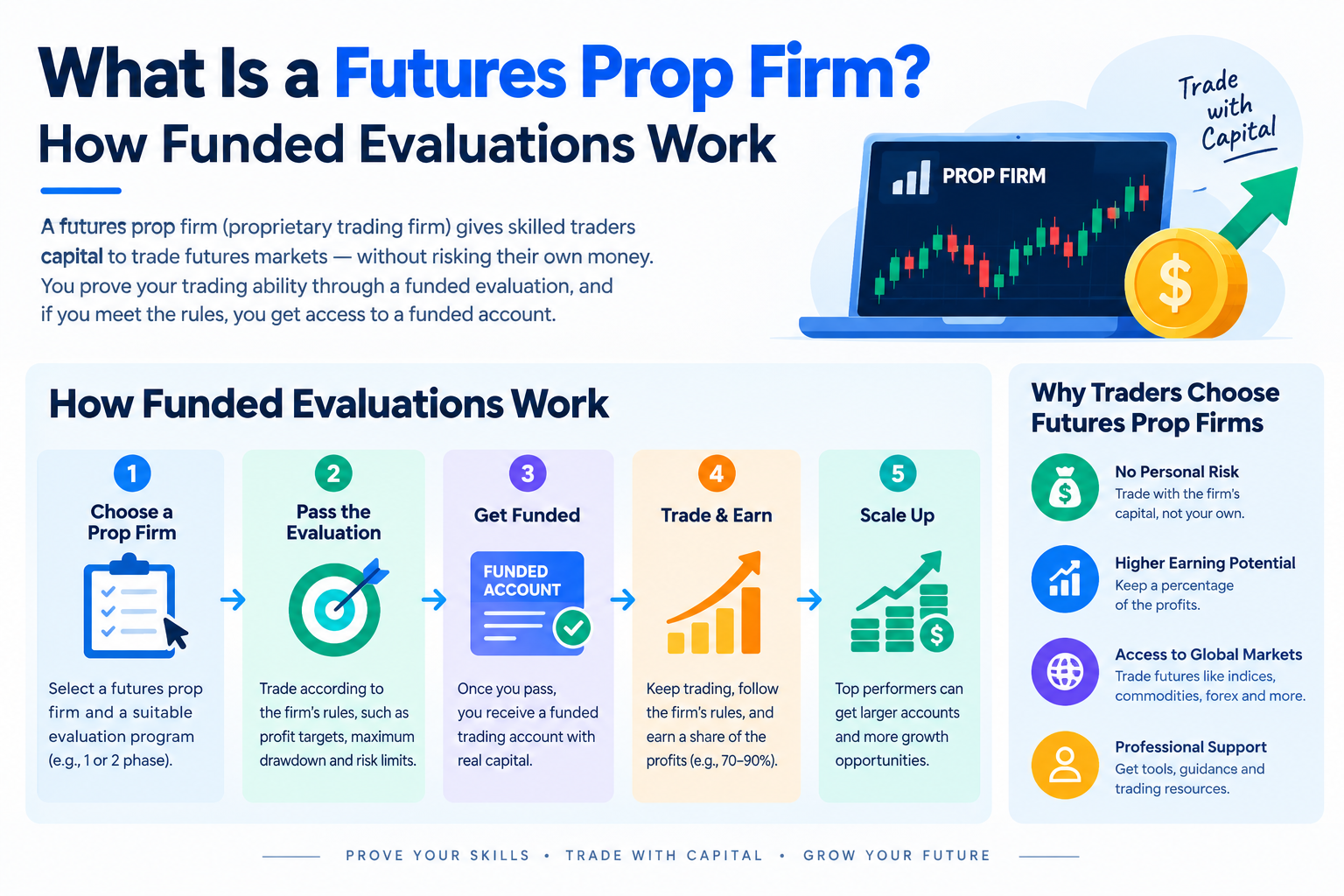
A futures prop firm lets you trade with the firm’s capital instead of your own, after you pass a paid evaluation. It sounds simple, but the rules, fees and risks differ a lot from firm to firm. This guide explains how funded evaluations usually work and what to check before you pay for one.
What is a futures prop firm?
A proprietary (prop) trading firm trades with its own capital. Traditional prop firms hire and train traders directly. Many online futures prop firms work differently: they sell evaluations to individual traders. If you pass, you get a funded account and keep an agreed share of the profits. For background, see proprietary trading and futures contracts on Wikipedia.
How a funded evaluation works
- Choose an account size and pay the fee. Fees can be monthly or one-time, and they are usually non-refundable.
- Trade the evaluation account. This is normally a simulated account that uses real market data.
- Reach the profit target. You must hit it without breaking any rule.
- Move to the funded stage. Many firms then give you a funded account, and often that account is also simulated. Profit payouts are paid by the firm under its own payout policy.
- Request payouts. Firms set minimum trading days, payout thresholds and profit splits.
Key terms to understand
Profit target
The amount you must earn to pass the evaluation, often a percentage of the account size.
Drawdown
The maximum loss you are allowed. A trailing drawdown rises as your profit rises, so your loss limit gets tighter. A static drawdown stays fixed. Some firms measure drawdown at the end of the day, others in real time.
Daily loss limit
The most you may lose in a single day. Break it and the account can be closed.
Consistency rule
Some firms require that no single day makes up more than a set share of your total profit.
Profit split
The share of profits you keep. Each firm sets its own split and payout schedule.
Fees to look for
- The evaluation fee, monthly or one-time
- An activation fee when you pass
- Reset fees if you break a rule and want to try again
- Data, platform and commission costs
- Payout minimums or payout fees
Risks and realities
- You can lose the fee. Passing is not guaranteed, and many traders do not pass.
- Funded accounts are often simulated. You are usually not trading a brokerage account of your own.
- Rules differ and can change. A small breach can end an account.
- Leverage cuts both ways. Futures can magnify losses as well as gains.
- Regulation varies. Many online funded-account firms are not regulated the way a broker is, so read the terms carefully.
How to check a prop firm before you pay
- Read the full rules and terms, not just the marketing page.
- Compare the drawdown type, daily loss limit and consistency rule.
- Check the payout policy: minimum days, thresholds and speed.
- Look for independent reviews and payout proof, not only the firm’s own site.
- Ask support specific questions before you buy, and keep the answers.
- Start with the smallest size you can afford, and only risk money you can afford to lose.
Frequently asked questions
Is a prop firm the same as a broker?
No. A broker places trades in your own account with your own money. A funded-account prop firm usually provides an evaluation and a, often simulated, account governed by its rules.
Do I trade my own money?
During the evaluation you pay a fee, and trading is usually simulated, so you are not depositing trading capital. You can still lose the fees you pay.
Are payouts guaranteed?
No. Payouts depend on meeting the firm’s rules and payout conditions.
Which drawdown type is better?
Neither is better for everyone. Trailing drawdown tightens as you profit, while static drawdown stays fixed. Choose the one whose rules fit how you trade, and read the details.
Final thoughts
A prop firm evaluation is a paid test with strict rules, not a shortcut to profits. Learn risk management first, practise on a simulator, and compare firms using the checklist above before you spend anything.
This article is for education only and is not financial, investment or trading advice. Trading futures involves substantial risk of loss and is not suitable for everyone.
BlueSky Pro is a social network. It does not offer trading accounts, funding or investment services. Not sure how we differ from sites with similar names? Read BlueSky Pro vs Bluesky vs BluSky Trading.